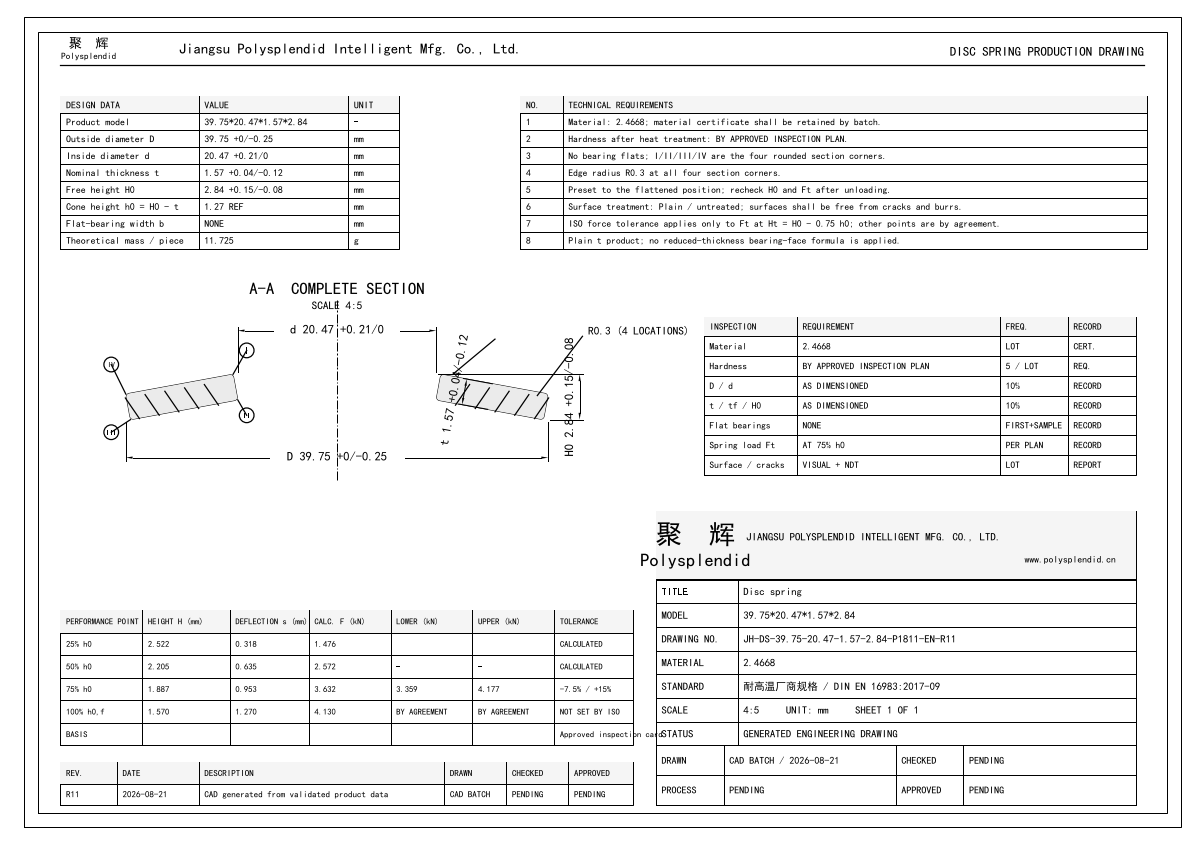
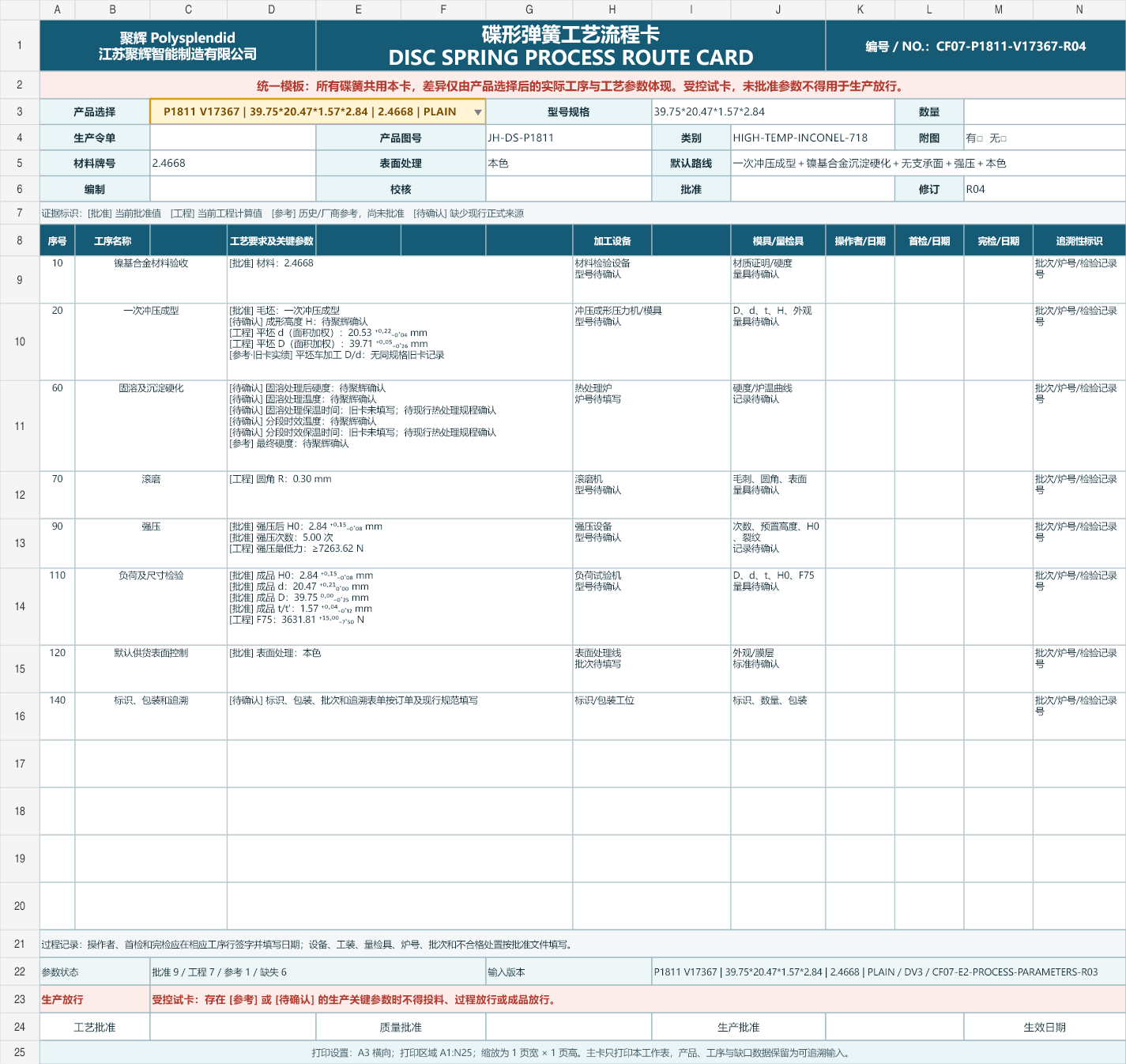
| Outside diameterD / De | 39.75 mm (-0.25/+0 mm); limits 39.5–39.75 mmThe high-temperature product keeps its material and vendor identity. Dimensional tolerances, coaxiality and guide clearances use the DIN EN 16983 general range rules; hardness is resolved separately from the material condition and vendor/order source. | Resolved | DIN EN 16983:2017-09EN 16983 page 12(PDF 14) |
|---|
| Inside diameterd / Di | 20.47 mm (+0/+0.21 mm); limits 20.47–20.68 mmThe high-temperature product keeps its material and vendor identity. Dimensional tolerances, coaxiality and guide clearances use the DIN EN 16983 general range rules; hardness is resolved separately from the material condition and vendor/order source. | Resolved | DIN EN 16983:2017-09EN 16983 page 12(PDF 14) |
|---|
| Product thicknesst / t′ | 1.57 mm (-0.12/+0.04 mm); limits 1.45–1.61 mmThe high-temperature product keeps its material and vendor identity. Dimensional tolerances, coaxiality and guide clearances use the DIN EN 16983 general range rules; hardness is resolved separately from the material condition and vendor/order source. | Resolved | DIN EN 16983:2017-09EN 16983 page 13(PDF 15) |
|---|
| Free heightH0 / l₀ | 2.84 mm (-0.08/+0.15 mm); limits 2.76–2.99 mmThe high-temperature product keeps its material and vendor identity. Dimensional tolerances, coaxiality and guide clearances use the DIN EN 16983 general range rules; hardness is resolved separately from the material condition and vendor/order source. | Resolved | DIN EN 16983:2017-09EN 16983 page 13(PDF 15) |
|---|
| Cone heighth0 / h₀ | 1.27 mm (-0.12/+0.27 mm); limits 1.15–1.54 mmWorst-case envelope derived from free-height and plain product thickness t tolerances; it is a reference, not an independent standard h0 acceptance tolerance. | Derived reference | DIN-EN-16983-2017-09EN 16983 page 13(PDF 15); EN 16983 page 13(PDF 15) |
|---|
| Coaxiality— | ≤ 0.32 mmThe high-temperature product keeps its material and vendor identity. Dimensional tolerances, coaxiality and guide clearances use the DIN EN 16983 general range rules; hardness is resolved separately from the material condition and vendor/order source. | Resolved | DIN EN 16983:2017-09EN 16983 page 12(PDF 14) |
|---|
| Flatness— | Set by approved drawing, process card or supply agreementThe standard does not provide a universal independent numeric tolerance; an approved drawing, process card or supply agreement must provide the acceptance value. | Agreement required | POLYSPLENDID-INSPECTION-POLICY-2026-08Task 121 标准原文核对结论 |
|---|
| Parallelism— | Set by approved drawing, process card or supply agreementThe standard does not provide a universal independent numeric tolerance; an approved drawing, process card or supply agreement must provide the acceptance value. | Agreement required | POLYSPLENDID-INSPECTION-POLICY-2026-08Task 121 标准原文核对结论 |
|---|
| Test loadFt | 3631.809961 N (-7.5/+15%); limits 3359.424214–4176.581455 NThe nominal test load comes from the current published standard, manufacturer, or engineering dataset; limits use the applicable DIN EN 16983 percentage tolerance. | Resolved | DIN EN 16983:2017-09rounded_almen_laszlo_calculation |
|---|
| Hardness— | material_condition_requiredFinished hardness for material 2.4668 shall be tied to its cold-work, ageing, or quench-and-temper condition and to a vendor/order source. The ordinary 50CrV4/51CrV4 range of 42–52 HRC is not reused. Structured vendor-condition values are stored as contextual inspection requirements. | material_condition_required | DIN EN 16983:2017-09— |
|---|